
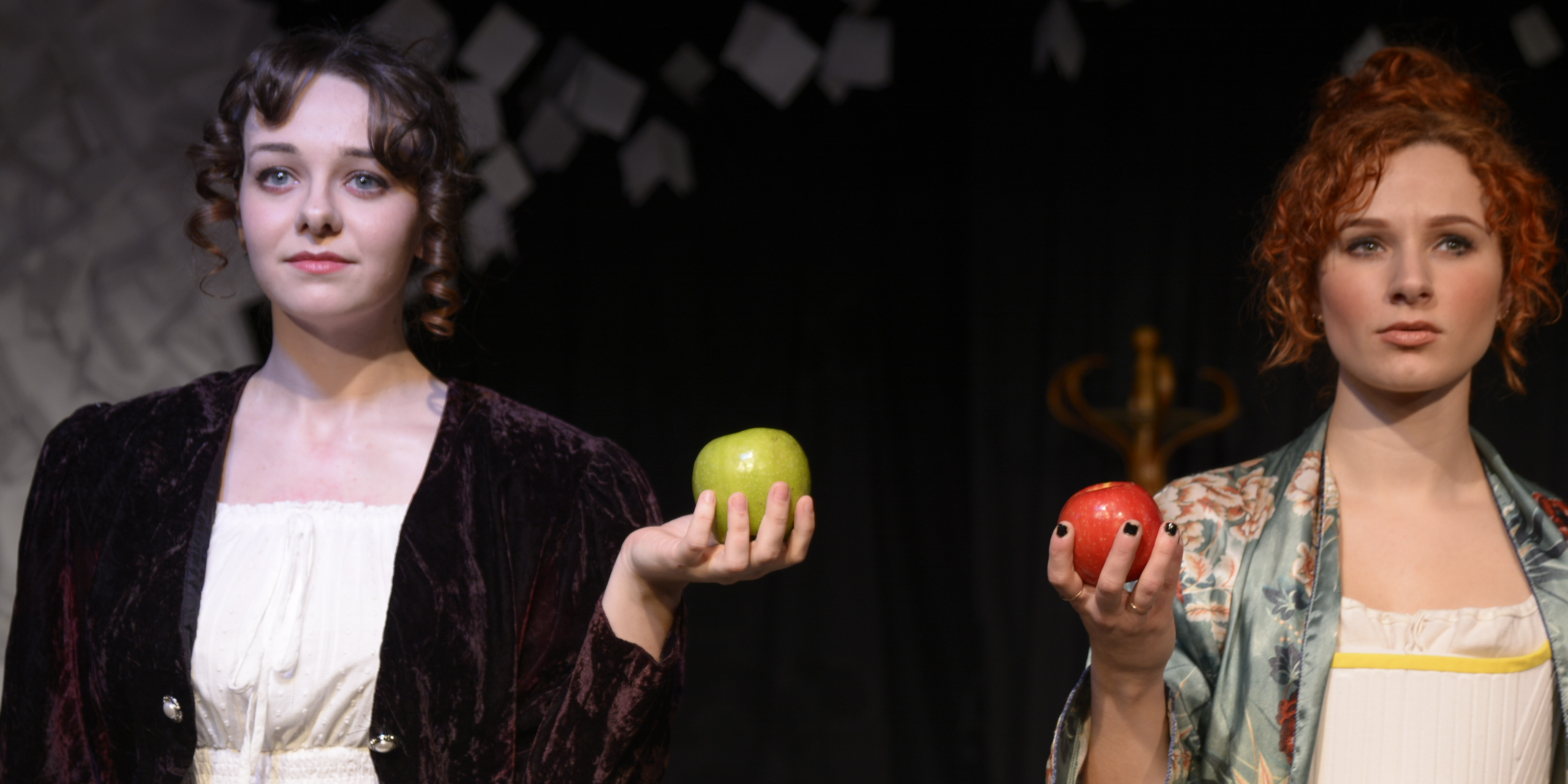
In April 2025, I had the honor of directing a staged reading of Jack Wolfram’s one-act play about Mary Wollstonecraft Shelley and the daughter of John Milton called Paradise Untapped as part of Annex Theatre’s Work in Progress series. This was a challenge on several levels because it not only required that I learn how to adapt a script for a production presented script-in-hand, but I also needed to produce it on a constricted timeline alongside another reading and a mainstage production.
About the Play
The play is dually-focused on Mary Shelley, author of Frankenstein, and Deborah Milton, the youngest daughter of John Milton, who wrote Paradise Lost. The play plays with historical fact and time in several ways, including the timing of Percy Shelley’s death and the possibility that Deborah Milton influenced the feminist leanings of her father’s epic poem.

Marketing Summary:
Deborah Milton, daughter of John Milton, and Mary Wollstonecraft Shelley entered our world a lifetime apart in England, born to world-renowned intellectuals and tethered across time by shared fiery intellect, circumstances of birth, and creative compulsion. As both yearn to make a name for themselves and share the stories each feels that only they carry, their isolated connectedness illuminates centuries of stories untold, writers never written, and a Paradise Untapped.(From annextheatre.org)
Script Summary:
This historically-sound work of critical fabulation emphasizes the distinction between namelessness and powerlessness through the mostly-true story of how the teenage girl responsible for one of the most widely-read stories in literature itself—*Frankenstein—*found both inspiration and solidarity in the uncredited work of a “canonical” English author’s youngest daughter, unbeknownst to them both. (From newplayexchange.org)
Background
The previous summer, the Annex Company (Which at the time was a small group in the post-COVID era.) selected Paradise Untapped for the production season, and I was hopeful about producing a full production on the off-nights along the other two shows. At the time, I anticipated that we would have more company involvement by the following spring. Once we transitioned from our immersive installation piece Leave Only Footprints to the first mainstage show of the season, GOLD, it was clear that the Annex Staff would not be able to help shoulder the production management burden. And I didn’t have the capacity to production manage GOLD and Paradise Untapped simultaneously. (This was also occurring during my dramaturgical and production support for two other readings, going work, and doing, you know… life.)
As it became increasingly more apparent that I would not be able to pull off Annex Theatre’s pre-COVID production format of producing a mainstage alongside an off-night, I pulled an audible and suggested to the Annex Staff that we shift Paradise Untapped into the Works in Progress slots and do it as a staged reading instead. They agreed. The costume designer (Anna Salizzoni) was already on board, and she was eager to apply her research skills and thrifty talents to the stage. After some discussion, she was open to paring down her designs while keeping them historically informed and free. Choosing to retain a costumed element in the reading helped to remind the audience and actors about the worlds we were inhabiting.

Adapting the Production
This was the third show in the Works in Progress series, so I had a burgeoning format to apply to table work, staging/tech rehearsals, and the performance schedule. In late January, I began with individual actor/character meetings to discuss each historical figure (or literary, as in the case of Frankenstein’s creature) and reconvened in mid-March to for approximately two weeks of table work and staging.
Onstage, the six actors were to have their scripts. We also had someone reading stage directions (Yolanda Suarez, who also took our beautiful production photos), and in a way they were a seventh actor because they were responsible for describing the world of the set we would not be able to see. Jack’s script includes detailed descriptions of scenic mechanics. Unfortunately, hearing the specifics about how various parts of the scenery would move became confusing to imagine on top of the set for the mainstage production and how the actors were required to interact with it. To compromise, I contained my edits to cuts to minimize confusion, and I only occasionally added words or phrases whenever it was absolutely necessary. It was an interesting tight wire act that I allowed me to practice my editing skills that would have been ideally done in real-time collaboration, if schedules had allowed.
During technical rehearsals, we focused on incorporating the costume elements and learning how to use some of the existing elements onstage. Our performance schedule slotted in two performances one week apart in order to work around the other shows. The original intention behind having one week in between was to allow Jack some room for textual adjustments, but because of the other constrictions with the staging and costumes, we stuck to the same script for both editions.

Janet Holloway-Thomas as The Creature and Hayley James as Deborah Milton. Photo by Yolanda Suarez. 
Bradley Goodwill as John Milton. Photo by Yolanda Suarez. 
Cast from L to R: Miranda Mars as Mary Wollstonecraft Shelley, Gerard Menendez as Sir Timothy Bysshe Shelley & William Godwin, Hayley James as Deborah Milton, Janet Holloway-Thomas as The Creature, Ronan Pirkle as Percy Bysshe Shelley, and Bradley Goodwill as John Milton. Photo by Yolanda Suarez. 
Janet Holloway-Thomas as The Creature, Ronan Pirkle as Percy Bysshe Shelley, and Bradley Goodwill as John Milton. Photo by Yolanda Suarez.
After the Show
I was glad that after each show, Jack was interested and available for an in-person talkback. The script had been through some development over the years as part of his doctoral thesis, and the talkbacks became a fertile ground for additional rich conversations in a new environment.
One especially interesting thread was about the portrayal of The Creature. The actor I cast in the role was trans and nonbinary, so we modified the script’s references to the creature to respect the actor’s pronouns. I specifically wanted to work with this actor on a project, and that role best suited their acting abilities. However, the resulting effect was a new layer that resonated with audiences and connected to academic and cultural discourse about gender and gender expression in Frankenstein. I find it fascinating how something that came from an unrelated casting choice and was not present in the script was something audiences picked up on and generated an interesting theoretical conversation that will help the playwright think about their work expansively.