
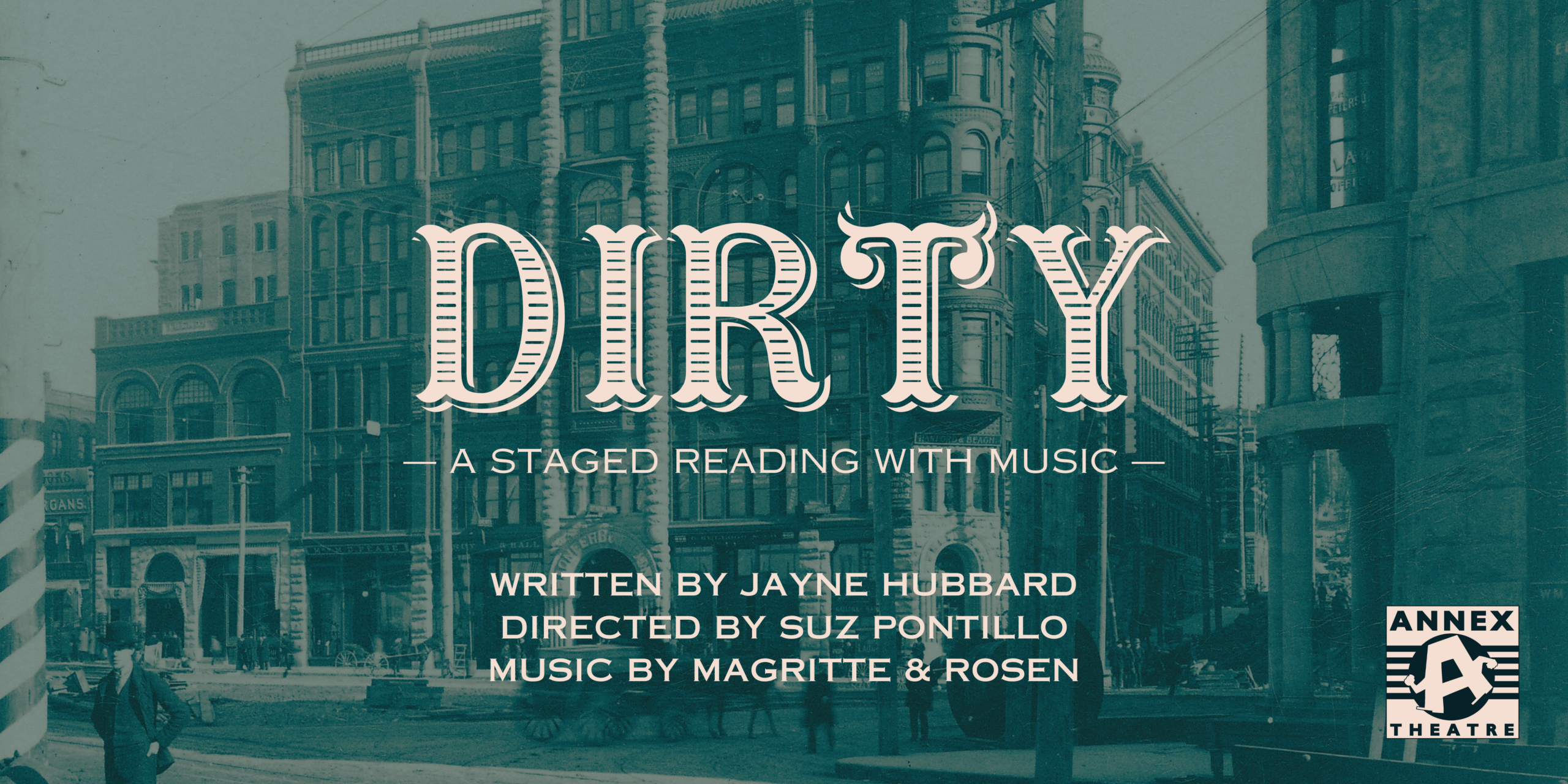
Featured image based on marketing design I created for the production.
My first opportunity to return to the role of Dramaturg in title was for DIRTY, a play with music in the Works in Progress series at Annex Theatre. DIRTY is a unique take on the story of Madame Lou Graham, one of Seattle’s most infamous figures, and I appreciated the opportunity to learn more about the economic development of the place I called my home for 16 years. Working on DIRTY also gave me a chance sink my teeth into a type of dramaturgy that first drew me to the practice, and I got to share that with the audiences of two sold-out performances.
About the Play
DIRTY by Jayne Hubbard
Directed by Suz Pontillo
Music by Magritte & Rosen
Works in Progress Reading at Annex Theatre
February 4 and 5, 2025
Summary: The year is 1892. As business magnates continue to rally the community to rebuild after a glue fire destroys most of downtown Seattle, everyone looks to the wealthiest person in town: local brothel owner Madame Lou Graham. A historical fiction with lots of music, DIRTY explores the complex lives of the most powerful figures in town: Seattle’s sex workers. (From web archive of annextheatre.org)


When Jayne first proposed her fully written play in two acts about Madame Lou, I knew it would be a perfect fit for Annex. It’s rare for someone to propose a complete script, and although we would not be putting on the full production, it was still a good chance to connect with a new-to-us artist and have a hand in the early stages of the work to encourage both to grow. Jayne was eager to utilize our resources for development, and we were able to offer her support with dramaturgy, casting, and the production tools needed for the reading.
At the time the play was selected, there were no composers attached and only placeholders for songs to come in the script. Jayne soon reached out to New York-based songwriting duo Magritte & Rosen to develop the work remotely. As part of the Works in Progress series, the music became the special technical/design element that Annex provided support for as part of the DIY-focused reading in the form of a unique monitor setup onstage and space for additional rehearsals to learn the music. (Read about the WIP series here to learn more.) The rest of the cast and creative team were assembled through a merged process of audition and invitation, all of whom breathed life into the work and gave shape to the stories of the women in the play.
Facilitation
My first love of dramaturgy came from being able to fully immerse myself in the world of a play, which early on was often historical (or Shakespeare). As I’ve developed my practice, I’ve come to learn how to serve the work even if it’s not about a specific point in history, but working on DIRTY felt a bit like coming home. I enjoy being able to learn as much as I can about a topic, but the work of the dramaturg—that I am continuously working on every day—is synthesizing and disseminating this information to the audience as context to complement their viewing experience. The work I completed on this play—in addition to being essentially a Production Stage Manager—was in one-on-one feedback with Jayne, participating in group feedback during an early reading, and creating a digital lobby display for the audience.
The feedback in the first reading was the pivotal point in the play’s development. The actors were invited—while also being considered as performers for the reading—and able to give crucial feedback about the relationships between the characters. The discussion delved deep into the hearts and minds of the women, and inspired Jayne to make some key changes before they went into rehearsals with the final cast. My contributions in that reading were mostly focused on the history, but I also got a chance to practice giving feedback in a group again, after many years of only doing one-on-one feedback or leading talkbacks.
Historical Research
The characters of DIRTY is based on real historical figures, but the plot and the relationships conveyed in the play are mostly fictional. This is because we know very little about Lou Graham and the women in her brothel, and what we do know may not actually be true. In Seattle, there is one historian who came to prominence in the 1960s and 1970s, Bill Speidel, and is credited with saving the rundown Pioneer Square area with essential historical tourism in the form of the Seattle Underground Tour. We’ve since learned that much of his knowledge about the characters featured in DIRTY and the people’s memories about the nuances of many major events of Seattle’s major economic and urban development—including the Great Fire and the Klondike Gold Rush—were primarily derived from oral history by talking to people who remembered stories from their youth and family members. This was essential and important work, and has created a strong narrative in Seattle that many people have been proud of for decades. However, coupled with the fact that the local history of women, people of color, and Indigenous people was conveyed from a white, cis-male, and sometimes dismissive perspective, the result was history that was overlooked and mistold.
The women who worked for Lou Graham are listed in the annals of history without last names, and sometimes with the same name, as with Annie #1 and Annie #2. The one image we have of Graham is not of even of her, and no one seems to agree on her date of birth. The fact that Jayne portrayed representations of these women with hopes and dreams and desires was, in its own way, absolutely radical.
While writing the play, Jayne conducted her own research to get inspiration, but as the play’s final version was locked in for performance, we weren’t able to make any further changes to incorporate new information. Since it was intentionally promoted as historical fiction, “new information” wasn’t actually relevant. But simultaneously, journalist Hannah Brooks Olsen self-published her formative book about Lou Graham that intentionally dispels a lot of the Speidel myths. As we moved toward production, the entire book became available and both Jayne and I read it. Jayne couldn’t make any changes to Lou’s arc (nor did she want to), but I was able to incorporate many of my takeaways into the digital lobby display I created for the audience.
Lobby Display
In order to cut down on printing costs at Annex, for several years that has been a slideshow that plays in the lounge area for patrons to view additional info about the current production, cast and crew bios, and other shows. To make the best use of this space, I created a digital lobby display—an alternative to the “traditional” dramaturgical lobby displays that one might usually see at a theatre to inform the audience about the context of the production—that was in this slideshow and the interstitial info in the live stream. I also included a QR code in the printed program that made the info available on the Annex Theatre website.
Timeline
1888: Madame Lou Graham opens her Wild West-era brothel, located at 3rd and Washington in Pioneer Square, Seattle, now considered a “major city.”
1889: An overheated glue pot starts the Great Seattle Fire, which destroys a majority of the business district and waterfront, including the Red Light District.
1890 – 1892: The rebuilding era in Seattle and the events of DIRTY take place.
1893: The stock market crashes triggers The Great Panic. The nation goes into a four-year economic depression. In King County, Lou Graham supports the financial recovery.
1897: The Klondike Gold Rush kicks off, bringing prosperity to the Puget Sound region.
1903: Madame Lou Graham dies in San Francisco.
The Great Fire
In the uncharacteristically dry heat of the afternoon on June 6, 1889, an overheated glue pot burst into flames on Front Street (now 1st Avenue), starting a fire that destroyed much of Seattle’s commercial and waterfront property. The damage spread from University Street to Dearborn Street and from Elliott Bay to the east, up to what is known today as 4th Avenue S. Volunteer firefighters from Seattle to Tacoma rushed to fight the fire, but it quickly spread out of control until it ran out of material to burn. Thankfully, no lives were lost.

Recovery began the next day with a public meeting, where nearly everyone resolved that there would be no wooden buildings and that the streets would be rebuilt wider, flatter, and higher. The once pioneer town was rebirthed from the ashes as a booming city.
Madame Lou Graham
What we “know” of Lou Graham is mostly invented, since there are no known surviving photographs, letters, or diary entries. Through public documentation, we do know some things. She was born Dorothea Georgine Emile Ohben in Germany in 1862, and emigrated to New York City at age 16. In her 30s, she ran a clean and elegant “bed house” with entertainment for prominent and important men.
After the building was destroyed in the Great Fire of Seattle in 1889, she bought up land, and constructed some of the first new buildings to reopen the city. She funded Puget Sound National Bank and construction of new buildings in Pioneer Square, and purchased land in Bellingham, Tacoma, and beyond.
As the city’s population grew and new leadership shut down the Red Light District at the start of the 20th century, Graham moved to San Francisco, where she died soon after, in 1903. With no will, no living descendants, and only the intent filed to naturalize as a US citizen, her assets were distributed among her siblings and strangers after her death.
Although she is credited with gifting the largest donation to the King County Education system, that is only evidenced by one of her former plots of land being home to the office for the Highline Public School district.
Further Reading
Notoriously Bad Character by Hannah Brooks Olsen (2024)
This is who we were: 1880 – 1899 by Laura Mars, Scott Derks, ed. (2015)
The Great Seattle Fire Of June 6, 1889 by Austin & Scott (1965)
Wicked Seattle by Teresa Nordheim (2020)
HistoryLink.org, The Free Encyclopedia of Washington State history