
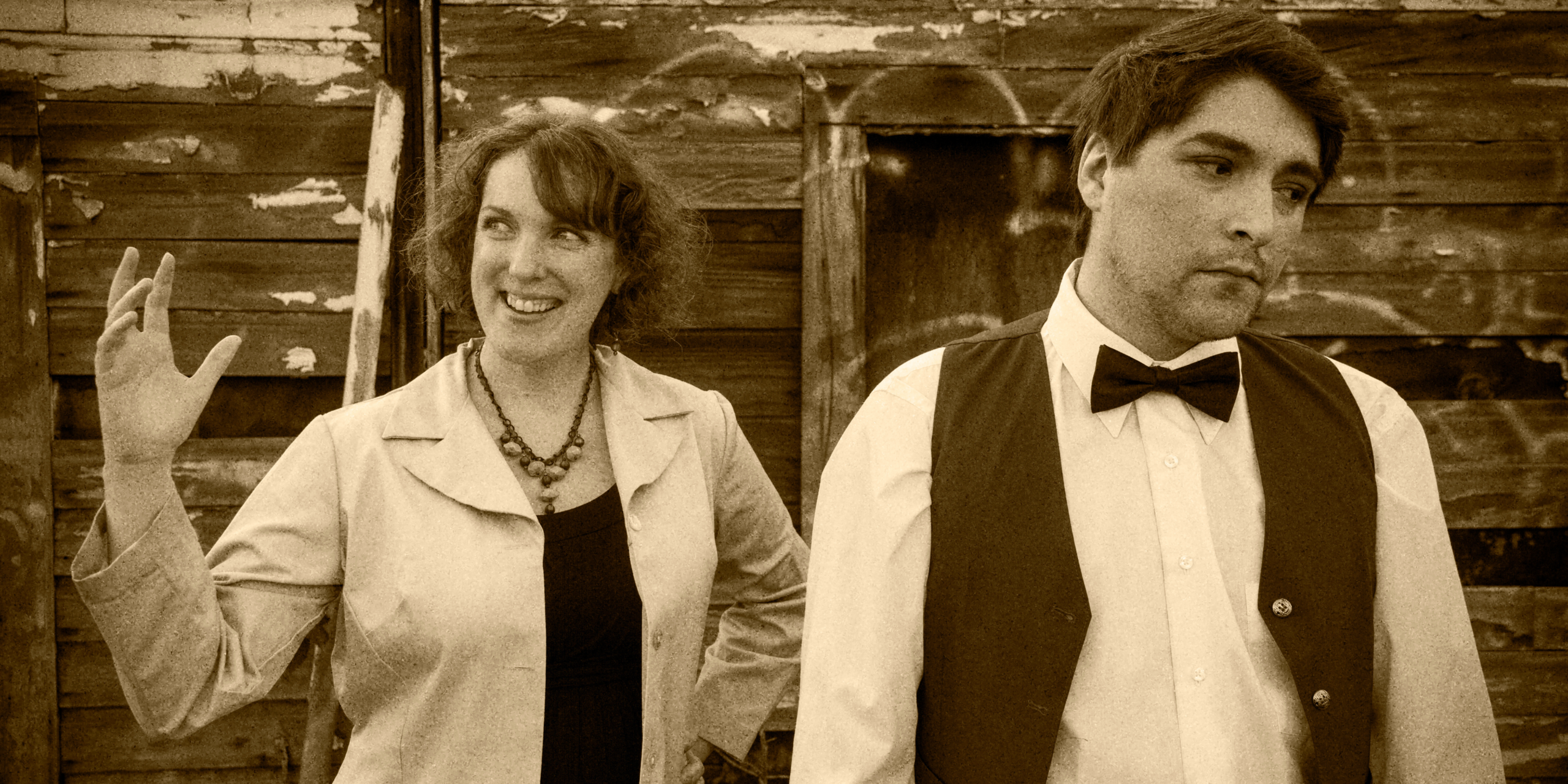
Featured image featuring Valerie Brunetto and Chad Ro. Photo by Laura Johnston.
From the moment I saw my first Kelleen Conway Blanchard play, I knew I wanted to work with her. In 2018, I asked her if she had a new play that we could propose to Annex Theatre. She did not have a full-length play in mind, but she was interested in connecting some of her previously established characters from shorter plays with an idea she had been thinking on for many years: a painting of a baby that had never been born but was treated as a full human with dreams and aims and birthdays. This became the seed for The Neverborn, which I directed and led the marketing for in the summer of 2019.
About the Play
The Neverborn, a creepy new comedy by Kelleen Conway Blanchard
Directed by Catherine Blake Smith
Mainstage production at Annex Theatre
August 2 – 31, 2019
Summary: After murdering the Matron at the Starling Home for Feeble Minded children, two orphaned sisters set out to find their–probably not dead–mother while being pursued by a tormented detective and a vengeful haunted baby painting. Annex’s Gothic Sweetheart returns with a magically creepy tale. (From web archive of annextheatre.org)

Pilar O’Connell, Chad Ro, and Madison Jade Jones. Photography by Laura Johnston. 
Chad Ro. Photography by Laura Johnston. 
Madison Jade Jones and Pilar O’Connell. Photography by Laura Johnston. 
James Weidman and Valerie Brunetto. Photography by Laura Johnston. 
James Weidman. Photography by Laura Johnston. 
Sasha Bailey and Valerie Brunetto. Photography by Laura Johnston. 
Mike Gilson and James Weidman. Photography by Laura Johnston. 
Valerie Brunetto. Photography by Laura Johnston. 
James Weidman. Photography by Laura Johnston. 
Mike Gilson, Zenaida Rose Smith, and James Weidman. Photography by Laura Johnston. 
Zenaida Rose Smith. Photography by Laura Johnston. 
Mike Gilson and James Weidman. Photography by Laura Johnston. 
Mike Gilson and Madison Jade Jones. Photography by Laura Johnston. 
Photography by Laura Johnston. 
Valerie Brunetto and Chad Ro. Photography by Laura Johnston. 
Pilar O’Connell, Madison Jade Jones, and Valerie Brunetto. Photography by Laura Johnston. 
Zenaida Rose Smith. Photography by Laura Johnston.
Rehearsals
Producing a show in the summertime at Annex Theatre is an immensely tough scenario to navigate because the theatre’s building essentially becomes an oven with its south-facing brick walls. To help us keep cooler heads, we had a new air conditioning unit that helped mitigate some of the worst heat, and new curtains in the house that the scenic designer installed to trap the heat in that remain in place to this day. But when the heat gets high, it’s important that the group vibes be immaculate. I primarily cast the play by invited auditions to try to maintain good working relationships with everyone, using it as an opportunity to work with some new-to-me actors who still understood how to approach Kelleen’s distinct style.
Directing work by an established playwright whose characters have a clear way of speaking was also a new (read: intimidating) experience for me. I trusted Kelleen and didn’t request changes to the script. Instead, we followed the bizarre and surprising ways that the characters in the story travelled through the different parts of the world like a video game. The orphaned children commit a heinous crime and flee to find their mother, when they meet a pair of aggressively bizarre performers. One of them has an overzealous and religious parent, and the other turns out to be on the same journey. The orphans are doggedly pursued by their past in the form of a haunted baby painting and the detective it corrupts (because there is never a ‘normal’ character in a KCB play). The orphans eventually find their mother, only to learn that it was probably not worth it after all because she is too obsessed with her human-animal hybrid creations. The stories for every character were clear on the page, but as with any new play, it was important to stay flexible.
The true gift of Kelleen’s work is that even though she has a very distinct writing style and includes similar archetypes in her plays, her productions can vary greatly depending on the type of people who are cast. Character styles will slightly shift to suit the actor in how they speak or carry their body. For The Neverborn, this meant that some costumes changed from what was originally written in the script to best suit the actors. The changes—although it may seem counter-intuitive to ignore directions in the script—enabled the actors to fully embody the characters and bring the playwright’s world to life.
Poster Design
In typical Annex fashion, along with directing the play (and fulfilling my duties as Artistic Director), I was also production managing and finishing the marketing for the play. I am fond of the bizarre marketing imagery I ended up creating, mostly because it was fun to make in Adobe Illustrator. We attempted to light a baby doll on fire and take a picture of that, but it turns out that was harder than we predicted. I ended up layering several pictures of the baby doll and the flames onto a found image of a picture frame along with several textures.

Production
The production was ultimately successful. We had our first rotating set on the Annex stage, which was a clever way to change locations to various unit sets without taking a drastically long time for scene changes. The scenic designer, Adam Zopfi-Hulse, also tackled costumes, and we combined his vision with the crafty drag-burlesque talents of Sasha Bailey, who played one of the characters in the play. Kelleen’s wife Violet Séverine Blanchard (purveyor of delightful physical media at Tomb of Treasure in White Center) composed some excellent atmospheric pieces that we integrated into the sound design. The production came together in delightful ways that made the show fun to watch, even as the darkness took over with the mystery of the neverborn painting and its affect on the detective.
During the run, one of our actors was ill and the cast quickly assembled to find a solution. Some of the actors volunteered to read the character’s part from a music stand set off to one side of the stage. We setup an alternative light that evening in the lighting cues so that the script was always lit, and the actors onstage kept room for the other character as their disembodied voice kept us in the scene. At first, I was immensely concerned that the outcome would be distracting, but it worked. As we proceeded through the run, we also saw one of the less experienced actors begin to take liberties with staging and stylistic choices that created difficulties among the cast, but we eventually steered the ship back to the right track.
Reception
It’s tough to sell any indoor activity during Seattle summers, but people did manage to see (and enjoy) the show. NW Theatre gave us a detailed and generous review (an excellent read for more detail than I provided here) and Kelleen Conway Blanchard was nominated for a Gypsy Rose Lee Award for Excellence in Local Playwriting, a critics’ award sponsored by Broadway World.
Overall, I felt like I had accomplished something by directing work by a beloved playwright, and the friendship bonds we cemented that summer persist to this day. I am not often driven by the specific stories of the plays I choose to direct, and instead I hook into the who I get to support and work with. This play was one of those times, and I will always remember it fondly.