
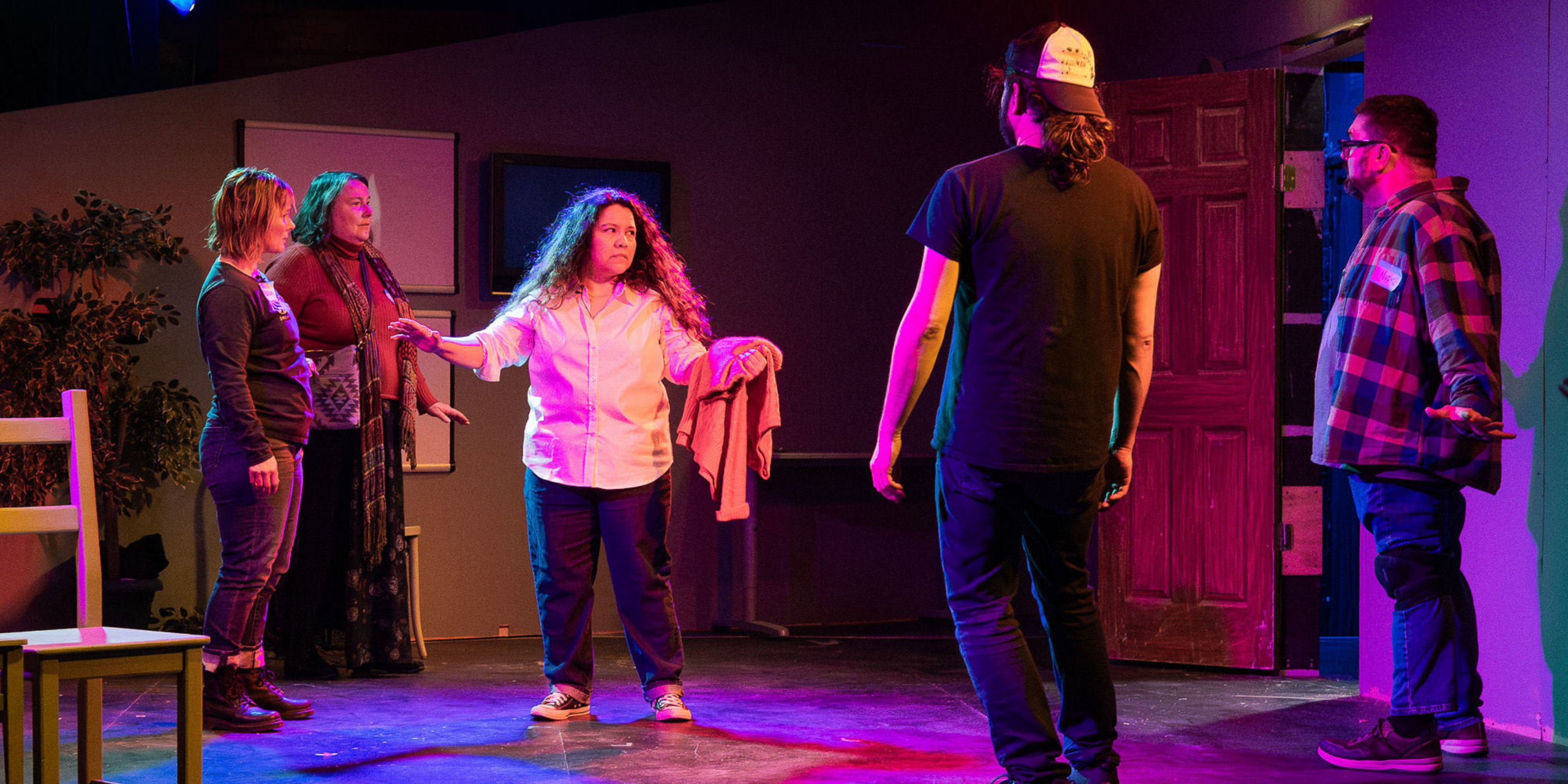
Featured image photography by Jennifer Kathleen.
I clearly remember the day I read the first version of THE PARTICIPANTS! by Jesse Calixto. I was enjoying a stolen moment to myself at Cal Anderson Park in the summer of 2023, and I was catching up on Annex Theatre’s first RFP (Request for Proposals) for mainstage shows after the COVID-19 pandemic. Jesse’s pitch was scheduled for that evening, but I wasn’t going to be able to attend. I was delighted to see that he had submitted a proposal, and I was eager to read it. When I finished reading the script, I felt like I had been punched in the stomach (in a good way). I immediately texted my friend who would be at the pitch to tell them that Annex Theatre needed to produce this play and that I should be the director.
Jesse Calixto is a talented actor and musician, but he is first and foremost a comedian. The draft of THE PARTICIPANTS!that I read eventually became the first act of an absurd play that is full of heart. It was a brave debut work, and I’m happy and proud to have played a part in the adventure.
About the Play
THE PARTICIPANTS! by Jesse Calixto
Directed by Catherine Blake Smith
Mainstage production at Annex Theatre
March 15 – 23, 2024
Summary: Four strangers are invited to participate in a focus group where they are asked to watch a trailer about an infamous hidden-camera prankster. Despite being told “Your opinion matters!” they suddenly begin to wonder if they themselves are the subject of a sick joke or a life threatening disaster. (From web archive of annextheatre.org)

(L to R) Dan Ruiz Salvatura, Rachel Taggart, Yolanda Suarez, Patricia Haines-Ainsworth, and M. Keala Milles, Jr. Photography by Jennifer Kathleen. 
Dan Ruiz Salvatura, Rachel Taggart, Yolanda Suarez. Photography by Jennifer Kathleen. 
Dan Ruiz Salvatura and Rachel Taggart. Photography by Jennifer Kathleen. 
M. Keala Milles, Jr. Photography by Jennifer Kathleen. 
Wilson (a talking tree). Photography by Jennifer Kathleen. 
M. Keala Milles, Jr. and Wilson. Photography by Jennifer Kathleen. 
Dan Ruiz Salvatura, Patricia Haines-Ainsworth, and Rachel Taggart. Photography by Jennifer Kathleen. 
M. Keala Milles, Jr. Photography by Jennifer Kathleen. 
Yolanda Suarez. Photography by Jennifer Kathleen. 
Rachel Taggart, Yolanda Suarez, and M. Keala Milles, Jr. Photography by Jennifer Kathleen. 
(L to R) Rachel Taggart, Patricia Haines-Ainsworth, Dan Ruiz Salvatura, and M. Keala Milles, Jr. Photography by Jennifer Kathleen. 
Dan Ruiz Salvatura and M. Keala Milles, Jr. Photography by Jennifer Kathleen. 
(L to R) Patricia Haines-Ainsworth, M. Keala Milles, Jr., Rachel Taggart, and Dan Ruiz Salvatura. Photography by Jennifer Kathleen. 
(L to R) Patricia Haines-Ainsworth, Dan Ruiz Salvatura, M. Keala Milles, Jr., and Rachel Taggart. Photography by Jennifer Kathleen. 
Rachel Taggart and Dan Ruiz Salvatura. Photography by Jennifer Kathleen. 
M. Keala Milles, Jr. Photography by Jennifer Kathleen. 
Rachel Taggart and M. Keala Milles, Jr. Photography by Jennifer Kathleen. 
Dan Ruiz Salvatura, Patricia Haines-Ainsworth, and Rachel Taggart. Photography by Jennifer Kathleen. 
Rachel Taggart and Patricia Haines-Ainsworth. Photography by Jennifer Kathleen. 
Yolanda Suarez. Photography by Jennifer Kathleen. 
Yolanda Suarez and M. Keala Milles, Jr. Photography by Jennifer Kathleen. 
Dan Ruiz Salvatura and M. Keala Milles, Jr. Photography by Jennifer Kathleen. 
M. Keala Milles, Jr. and Dan Ruiz Salvatura. Photography by Jennifer Kathleen. 
Rachel Taggart and Patricia Haines-Ainsworth. Photography by Jennifer Kathleen. 
Rachel Taggart and Patricia Haines-Ainsworth. Photography by Jennifer Kathleen. 
Patricia Haines-Ainsworth, Rachel Taggart, and Yolanda Suarez. Photography by Jennifer Kathleen. 
(L to R) Rachel Taggart, Patricia Haines-Ainsworth, Yolanda Suarez, M. Keala Milles, Jr., and Dan Ruiz Salvatura. Photography by Jennifer Kathleen.
Synopsis: The marketing description was intentionally brief because the second act is so out there, and we didn’t want to go into a lot of detail. For posterity’s sake, I’ll include more detail with some spoilers.
Act 1:
In the first act, the four strangers—a libertarian skeptic, a type-A barista, an older homebody who misses her dogs, and a guy who just came for the gift card and brought his own beer—are greeted by James, the focus group leader who is not who he seems. They give up their phones for the session, and James shows them a trailer for a new movie about a prankster character, El Camaleón (who looks a lot like James). He asks for their opinions, and it’s clear that none of them agree.
James leaves, and we hear a large boom outside the room. Convinced they’re being pranked, they lose patience and their fragile connections fracture. As they come to the realization that they are truly on their own, there’s a fire alarm. Smoke comes into the room. Some of them start to feel hot, and they check the TV to see if they can learn anything from the outside world. Some of them hear a voice who says they’re going to go get help. Even more divided, they resort to peeing in the potted plant and come together for a brief moment as they sing over the older woman’s relief. Then things come to a head: they bang on the door, there are gunshots outside, the lights black out, and they pass out. On the television screen, we see El Camaleón do his prank line, ¡Sorpresa!, then reveal he is James and say his signature line: Cool cool cool, let’s begin.
Act 2:
In the second act, we see each of the four wake up from their passed out positions in a sequence of memory/dream scenes. In between each scene, James delivers a single monologue about the nature of the universe and opinions.
Phil, the guy with the beer, hallucinates that the potted plant is talking to him as his girlfriend breaks up with him. After she leaves, he tries to follow her but he can’t get out of the room. Anita, the older woman, is confronted by her adult children about refusing to move to be treated for her ill health. After Anita reminisces about her life in the house, she decides that she does want to go but when she tries to follow them, but she can’t leave.
Walter—the real person behind the personas of James and El Camaleón—is giving a live TV interview about his political views about why he dares to provoke racist Americans with his pranks. The scene freezes and James interrupts him on the television to tell him what to do next:
Walter, there won’t be time for that. Time is the biggest joke of all! It is simultaneously infinite and fleeting, it is both always and never again. You are about to wake up to both. You will go first and then you will bring along the others. Not today, but soon. If you look hard enough you will begin to see the cracks in the corners of the world. You just need to listen and look.
Walter can’t leave the room during this sequence when the moment is frozen. When the interview resumes, he walks out the door.
Nick, the libertarian, is a young boy who witnesses his parents breaking up. His dad plays and sings him a song, and then leaves him forever. Nick tries to follow him, but is told to go back to bed. He doesn’t get to attempt the door. Rebecca, the type-A barista, is avoiding her sister’s funeral because of political divisions in her family. When her aunt comes, they have an impromptu memorial in the hotel room. Rebecca hears the same voice sequence the focus group heard, and she opens the door. There is no one there, and the worlds overlap back to the end of act one.
James is on the TV and invites them all to stand up. Walter enters, takes their name tags, and they each exit through the door. On the television screen, we see a burning building on the news. It turns off, and the play ends.
Script Development Process
After we selected Jesse’s play for the season and I agreed to direct it, we knew it needed to become a full-length. To support Jesse in his writing efforts, we invited some actor friends to join us for two workshops that I hosted one week apart. My goal was to bring in people who could read the script at Jesse’s level of talent and also offer him dramaturgical feedback to flesh out the characters and stories.
The result exceeded my expectations. On the first day when we read the first draft, our conversation spun out for at least an hour as we discussed several potential directions for the characters and the extended plot. Armed with my near-verbatim notes, Jesse wrote furiously for the next week and delivered a full-length version the following week that we read through together. His revisions merged some of the feedback we discussed with even more creativity. Although we had some different actors in the room, we were still able to see and discuss the changes together as a group.
Jesse and I then had a script to show to potential cast members for auditions. We also continued to refine the script in further iterations before giving the final version to the designers and the cast.
Rehearsals
After casting—I was happy for Jesse to be involved because of his breadth of experience as an actor—we began rehearsals. The most difficult part of the process was developing and maintaining effective communication between myself and Jesse. While he was in rehearsals and performances for a professional production, I was also dealing with personal changes in my life and an incredibly difficult work situation. I made some errors in judgement by not including him early on in discussions around some options being offered in rehearsals, especially for the song. However, by the time he attended a stumble-through of the play with the entire cast, he was able to give feedback from his perspective as an actor, and we discussed where to move forward with the piece. The play had a nice shape at this point, and the feedback was about specific character moments that we continued to refine.
Some people may balk at the idea of the playwright giving feedback on the acting and directing choices for a play. In this case, it worked. Not only do I trust Jesse’s instincts when it comes to acting—he is the professionally trained actor, not me—but it was his play and it was a new script. There were things he was learning too, and the lessons only became clear when he wasn’t see what he imagined would be on the stage. The rehearsal process offered lessons in how to include clearer cues in the script for a preferred final outcome that he can apply to future plays.
Production and Design
For many of us involved in the project, this was our first full-length production after COVID. There were illnesses, travel and work schedules to negotiate, and top things off, everyone was a volunteer. None of that is new to producing at Annex Theatre, but it felt new when we were navigating it after being away for so long.
I also gained a lot of experience by working with this cast. When I’ve directed other shows, it has just worked out that I only include a small number of new-to-me actors in the cast. But for THE PARTICIPANTS!, it ended up the other way, and I was managing a lot of unfamiliar working styles. Some folks in the cast and production team were neurodivergent, and I was often the youngest in the room. I learned when to listen to input from the actors and when to apply a stronger hand to moments I wanted them to work toward, all without having a more emotionally connected way of communicating.
The design of the show also introduced several converging ideas into a compressed time period between lights and scenic, but it was an exciting mix of videography, projection, and live music in addition to the traditional theatre design. We projected directly onto a television screen built into the set, and recorded many of the videos early on in rehearsals. The scene with live music was authentic to Jesse’s style. Learning the song came together in the tech weekend when were all able to be in the same room at the same time. Having to make aesthetic decisions early on in the process and connecting them later to the realities of the production is a difficult thing to navigate, even more so when it’s new work.

Outcome and Reception
Ultimately, the project was a success. We got one review from NW Theatre, which had a tough title, but more friendly URL: This Play Is Definitely the Worst | https://www.nwtheatre.org/2024/03/22/these-participants-might-surprise-you. The review was favorable overall:
The cast is versatile, which allows them to cover quite a few bases as the present and backstories collide and meander. Playwright Jesse Calixto has a good intuition for comedy (and there are some great bits of that on display here), but the layers underneath the brash surface are keen ones. Director Catherine Blake Smith, former Artistic Director and longtime curator at Annex, has a strong sense of making all those layers play out on the fringe stage. There’s a lot of This shouldn’t work, but it really does going on here.
…
At a time when humanity burnout is real, and fuses for terribly acting people couldn’t be shorter, it couldn’t come at a better time.
Jesse also received a Gregory Award nomination for Outstanding Original Script, which is a high honor. I believe the folks who did see the work were impressed with the big swings he took and moved by the touching messages about connection. These moments shone through the dark, and I will always look on this process with fondness for the lessons learned and connections made along the way.
